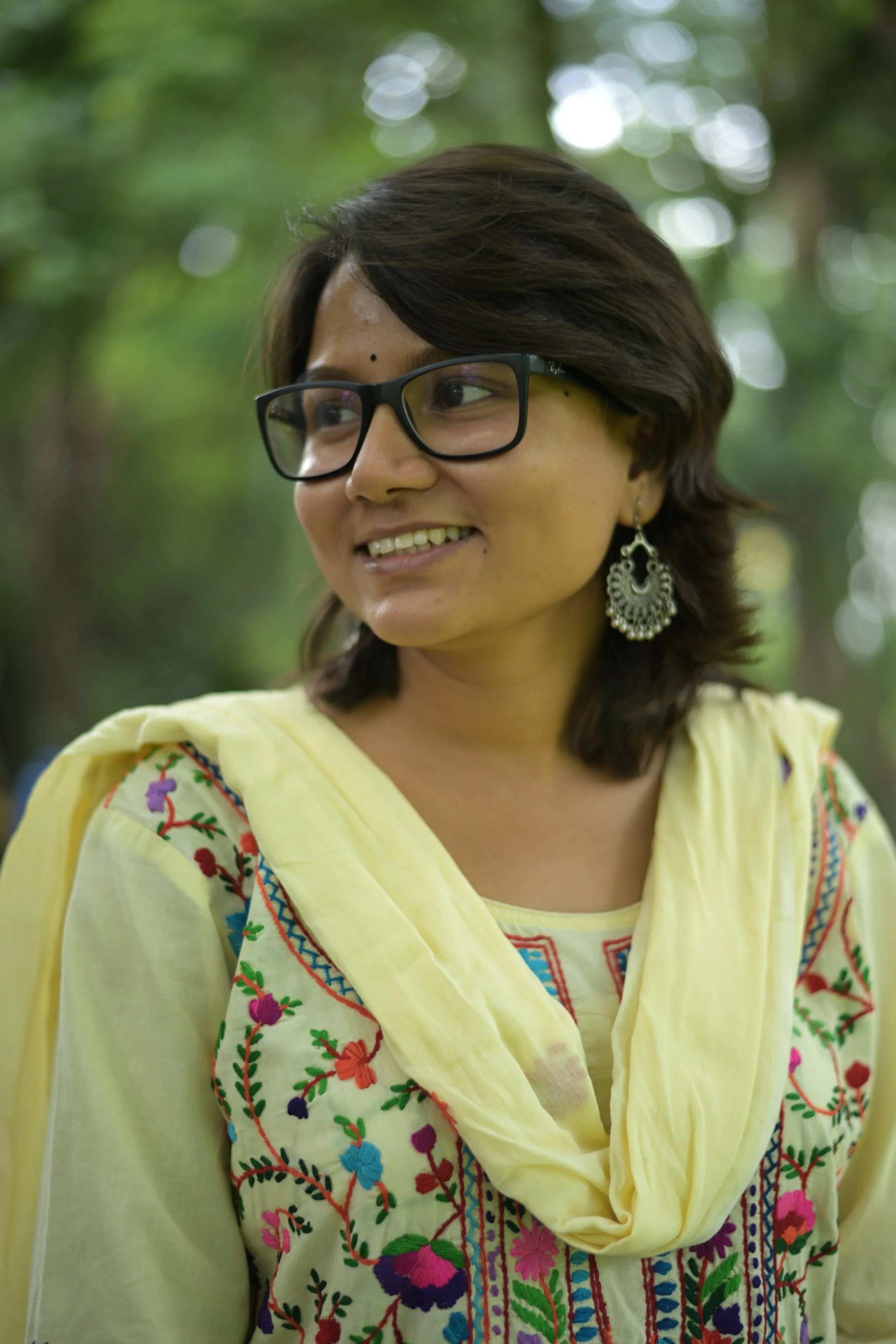
Stuti Priya Lakhar
I like daydreaming. Ever since I was a child, I liked escaping into the world of imaginations. I grew up reading and watching fantasy stories and for a long time (and maybe still), I liked to believe that I too have magical powers. Air, Water, Earth, Fire and Tree- the five elements in many Power Rangers and those kinds of series. I believed that my element is water. No wonder, I loved swimming. The only activity in my life where I was 100% sincere. Flow. Flowing like water. I also dance in waves. Especially when I feel I can flow with my energy- Is that my chi? I wonder?
My name, Stuti Priya means to love praying. And I do pray through my dance- that worships the beauty of the universe that God created. As I listened to a senior Sattriya artiste say, rasa exists in the beauty of this world- in the laughter of a child, a soothing breeze on a hot day, the pretty pink of a flower in a dark green bush- rasa is what I worship when I dance and surrender to Krishna.
As a student of history in Indraprastha College for Women in the University of Delhi, my teenage years were filled with the architecture of Chandni Chowk, Mughal court politics, Premakhyans, Amir Khusrau and Orsini’s take on medieval literature in the Indian subcontinent. I was deeply influenced by the Bhakti and Sufi movements, especially their ideas of Bhakti and “fana” respectively further inspired my dancing.
During my internship as an M.A. Development student in Azim Premji University, I first went and stayed in a reserve forest village in Assam. Being an urban kid, I was amazed by the knowledge system that existed among the local communities. This took me to intern and work in rural communities with indigenous communities in Assam. For me, middle school was a very special period because that is when my love of academic learning started. Following my cousin brothers, I would ponder over encyclopedias for hours. I wanted to share this love of learning because of which I became a middle school social science teacher at The Hummingbird School in Majuli, Assam. Working in an alternate community school with colleagues who were passionate about their respective subjects and had fun working with kids, I learnt to teach in experiential ways. Some of my happiest memories were from when the children would bring in new insights and new questions to ponder about. I never imagined that teaching middle school students would be intellectually stimulating. One of the best parts of teaching was when I guided them in projects where children developed their own research questions and explored different projects. The classroom was also a loving space because of the bond, fun moments, mischief and laughter we shared. I never knew caring and loving others would give me so much strength.
Living and working with communities with rich indigenous knowledge systems, I noticed a remarkable ease and familiarity in the way they could identify so many leaves and plants and navigate their way through forests, bushes and streams that spoke of a different way of being. It is this knowledge system, this way of being that I want to know more about and strive to conserve and adapt to in this neoliberal world. I often wonder what these ways of being tell us about ways to fight climate change.
I am an aspiring development practitioner who wants to work for forest commons at the intersections of ecology, economy and equity.